Most team building goes wrong in the first ten minutes. Forty people stand in a function room, someone explains the rules through a microphone, and the quiet half of the office decides to spend the afternoon being invisible. The activity isn't usually the problem. The group size is.
We've run corporate sessions at Marina Square since 2013. Below are twelve things Singapore offices actually book, what each is good for, and where each one falls over. We run three of them — escape rooms, free-roam VR and Lava Floor — and we've been straight about where those don't fit either.
The rule that matters more than the activity
The number that decides whether someone participates is how many people are in the room with them. In a group of six, staying silent is conspicuous. In a group of forty, it's free. Whatever you pick, the real design decision is how you break the headcount up.
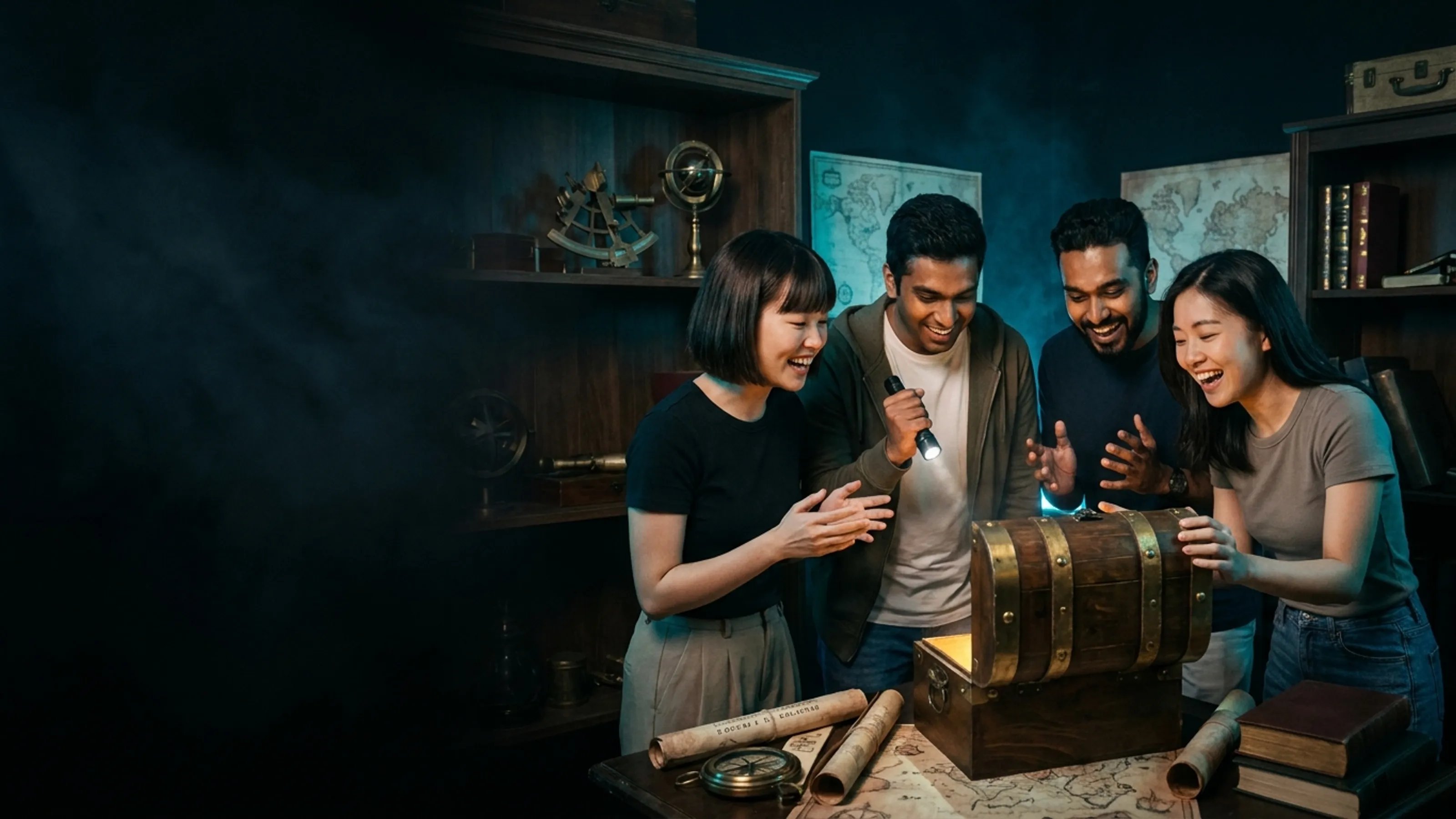
Our escape rooms take 2 to 8 players each, which is not a limitation we apologise for — it's the size where a team of strangers has to talk to each other. Three rooms run at once, so 24 people can be playing simultaneously in three separate teams, all racing the same 60-minute clock.
How to read this list
Three questions separate the activities that work from the ones people endure. Does every person have something to do at every moment? Does it split cleanly into small teams? And does it still hold up when the group is mixed — different ages, fitness and seniority, plus one person who would rather be at their desk?
Each entry answers those. The group sizes are the sizes the format handles well, not hard caps.
1. Escape rooms
Best for mixed teams, first-time organisers, and anyone who wants people talking within five minutes. Works at 2 to 8 a room, with as many rooms in parallel as you need.
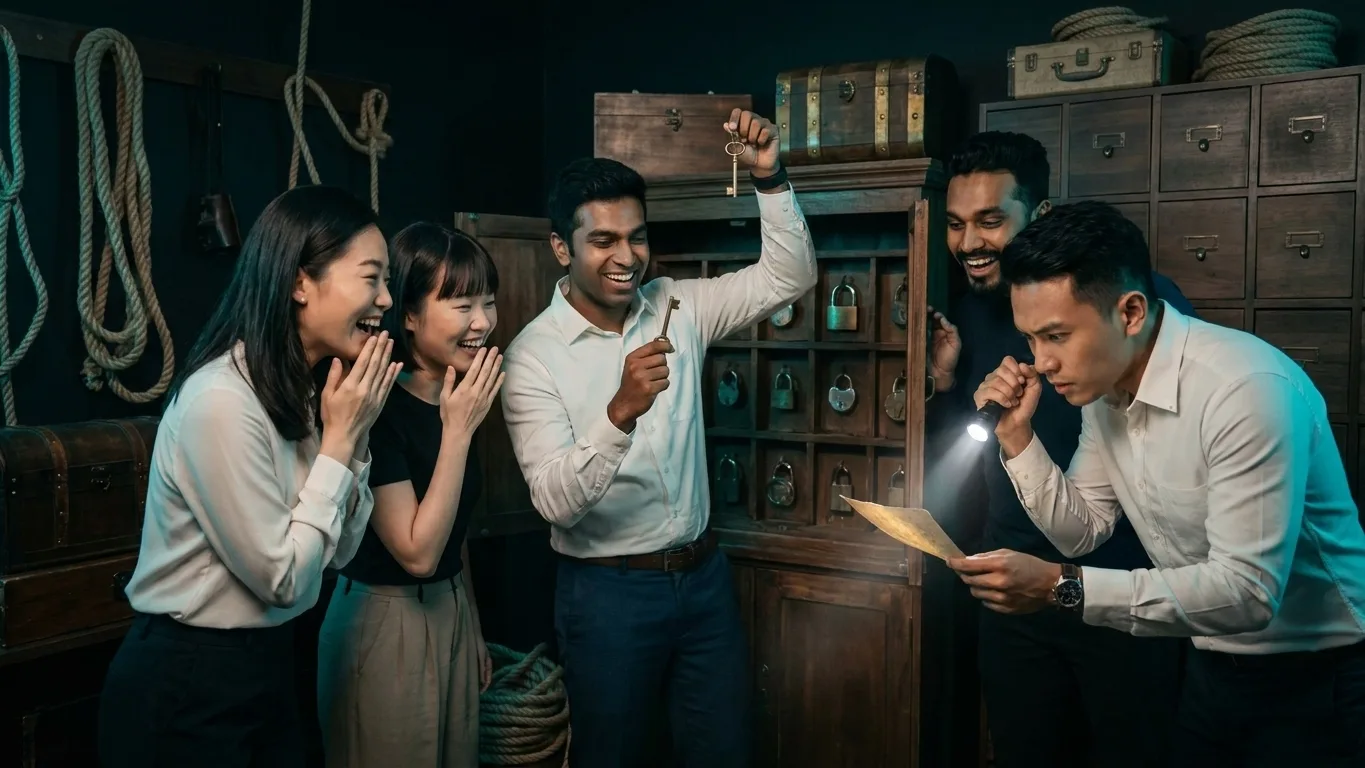
A locked room, a story, and a chain of puzzles that opens the door in sixty minutes. It works as team building because the clock does the facilitating for you. Nobody has to be told to delegate — they run out of time if they don't. The quiet colleague routinely turns out to be the one who cracks the finale, which is the part managers remember.
Where it falls flat: one room for a big group. Eight is the ceiling before people start spectating. If you have thirty, you need several rooms running at once, not one room and a queue. All six of ours sit on one floor for exactly that reason.
2. Free-roam VR
Best for teams that have already done escape rooms. Works at 2 to 4 a game.
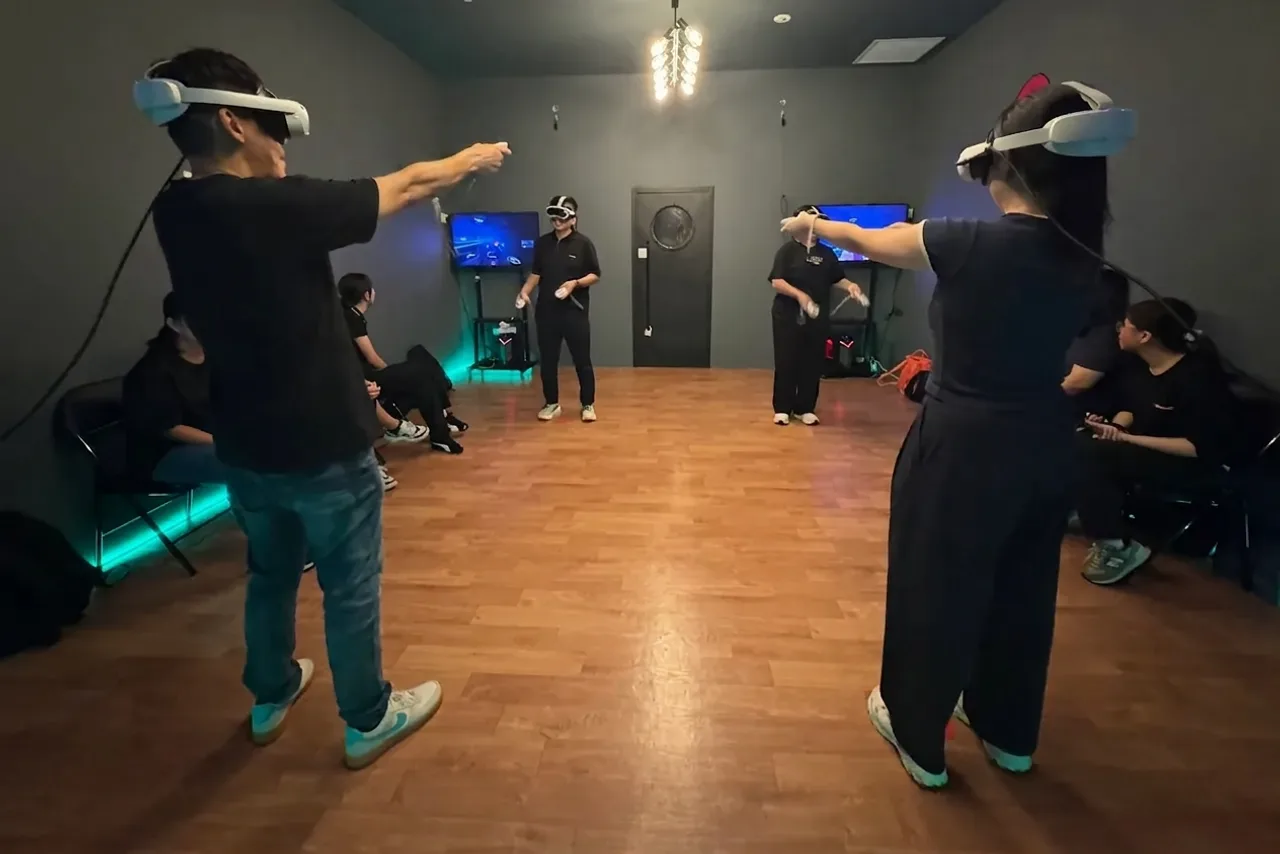
Same sixty minutes, no physical set — you walk around inside the game wearing a headset. The puzzle load is heavier than a real room, because a virtual space isn't limited by what fits in a real one. Nobody needs to have used VR before; there is a briefing first.
Where it falls flat: fewer players a game means more rotations to schedule, and there is always someone who would rather not put a headset on. Have a second activity for them. The VR floor is on the same floor as the rooms, which makes that easy.
3. Amazing Race-style city hunts
Best for big groups and teams that like being outdoors. Splits into as many small teams as you want.
Teams work through checkpoints across a district on their phones. It scales better than almost anything else here, because the format doesn't care whether you have 20 people or 200 — everyone is moving independently. It is also the only one on this list where the venue is the city, so you aren't paying for a room.
Where it falls flat: Singapore weather, and footwear. A downpour turns it into a group of damp people sheltering in a mall. Have an indoor fallback, or run it through an air-conditioned stretch.
4. Lava Floor
Best for mixed ages, for the slump after lunch, and for groups with kids attached. Two rooms, quick rounds, high throughput.
An LED floor game. Green tiles are safe, blue tiles clear the stage, red tiles are lava, and the only way across is together. Rounds run up to 25 minutes, it is playable from age 6, and it is the one activity on this list nobody needs told twice.
Where it falls flat: it is loud and physical, so it makes a poor solo booking for a team that wanted something cerebral. It works best as the second half of a rotation, which is how it sits on our corporate floor.
5. Laser tag and archery tag
Best for competitive offices and younger teams. Two sides, rotated.
Physical, loud, and genuinely fun for the people it suits. The team-building content is real but shallow — you find out who is competitive, which you probably already knew.
Where it falls flat: fitness and dignity. There is usually a portion of the office who will not run, and an activity that asks them to either excludes them or embarrasses them. Check before you book, not after.
6. Cooking and baking classes
Best for teams that already get on, at smaller headcounts. Pairs or small stations.
Everyone has a job, everyone eats at the end, and the pace is conversational rather than competitive. It is the best option here for a team that doesn't need breaking down so much as topping up.
Where it falls flat: dietary requirements and station counts. Both put a hard ceiling on the headcount, and the cost per head tends to climb faster than the group does.
7. Craft workshops — terrarium, candle-making, art jamming
Best for quiet teams, low-energy afternoons, and anyone recovering from a heavy quarter. Scales well, with everyone at their own station.
Calm, tactile, and people take something home. As a scheduling object it is very easy: one room, one facilitator, everyone works in parallel.
Where it falls flat: parallel is not collaborative. Twenty people making twenty terrariums is twenty individual activities in the same room. Lovely afternoon, not much team in it. Pair it with something that actually requires cooperation.
8. Bowling, darts and pool
Best for after-work and small teams, with no planning required. Natural groups of 4 to 6 a lane or table.
The default, for good reasons. It is cheap, it is booked in one phone call, and nobody needs talking into it. Small groups form around each lane on their own.
Where it falls flat: it is a social, not an exercise. If the brief was to get two departments talking, bowling will happily let them stand in the same building without doing it.
9. Axe throwing
Best for novelty, and for teams that have done everything else. Small lanes, rotated.
Memorable, and the safety briefing does more team-building work than people expect — everyone starts level as a beginner. Good for a room with a lot of seniority baked into it.
Where it falls flat: waiting. Throwing time per person is short, so a big group spends most of the session watching. Budget more lanes than feels necessary.
10. Sports day and inflatables
Best for large companies and family days — an annual event rather than a quarterly one. Very large groups.
The one format built for hundreds. Multiple stations run at once, people self-select into what they can manage, and it produces the photographs the comms team needs.
Where it falls flat: it needs space, weather and real organising effort. This is an event, not an afternoon, and it usually needs a vendor who does nothing else.
11. Volunteering and CSR days
Best for teams that want the day to mean something. Group size depends entirely on the partner organisation.
Done properly, it beats everything else here for how people feel afterwards. Done as a photo opportunity it is worse than doing nothing, and staff can tell the difference immediately.
Where it falls flat: lead time. Good partners are booked out and plan months ahead, not weeks. Don't reach for this one in a hurry.
12. Dinner, drinks and karaoke
Best as the end of something. Any headcount, though conversation caps at about 8 a table.
It isn't team building and you shouldn't put it on the invite as though it is. But it is the best closer there is. An hour of doing something together, then food, beats either half on its own.
Where it falls flat: alone. A team that only ever goes for dinner sits with the people it already sits with.
How to plan a half-day for 20 to 50 people
The pattern that works: split the group, run two activities in parallel, then swap at the halfway point. Half the room plays escape rooms while the other half plays something physical, then they trade. Nobody queues, nobody watches, and the two halves have something to argue about over lunch.
For a mixed group, pick one thinking activity and one moving one. For a team that already knows each other well, pick two of the same kind and make it a competition. Either way, book the rotation rather than the activity.
Tell us your headcount and your window and we'll plan the rotation around it — that is the part we are actually good at. If the venue has to hold the whole day, the corporate event venue guide covers what to ask. For something wider than the corporate case, group activities in Singapore goes broader.
What team building costs per person
At our end: escape rooms and VR escape games run from $24 a person on weekdays and $30 on weekends and public holidays, for a 60-minute game. Lava Floor is from $13. A mixed half-day is quoted off your headcount and the mix, and you get one number back rather than a proposal deck.
Across the rest of the list, the honest answer is that cost per head moves with how much of the vendor's time you are buying. Anything with a facilitator at every station — cooking, crafts — costs more per person than anything where one person runs the whole room. Budget around facilitator count, not activity type. Our full price list is on the FAQ.
The mistakes we see most
- Booking one activity for the whole headcount, then discovering half the room is queueing.
- Picking something physical without checking who in the office can't or won't do it.
- Leaving no gap between activities. The ten minutes between games is where people actually talk.
- Scheduling the whole thing straight after lunch, when the energy is lowest.
- Calling drinks a team bonding activity on the invite. People notice.
- Asking six vendors for a proposal, then choosing on price. Ask two, and ask them how they would split your group.
None of those are about which activity you choose. They are about how the day is shaped, which is the part most invites get wrong before anyone turns up.